
Foot drop after a slipped disc – causes, symptoms and modern support options

Eine Frau mit Bandscheibenvorfall und Fußheberschwäche hält sich den schmerzenden Rücken
A slipped disc is one of the most common diseases of the spine and can have far-reaching consequences for the everyday life of those affected. In addition to severe back pain, neurological symptoms often occur – including weakness of the foot dorsiflexion, medically known as peroneal nerve palsy. But how does weakness of the foot dorsiflexion develop with a herniated disc? What are the symptoms and what modern support options are available today?

What is weak foot dorsiflexion?

In the case of foot drop, the ability to actively lift the foot is limited. This is usually caused by damage to or irritation of the peroneal nerve or the nerve pathways involved in the lumbar spine.

Those affected often notice:

  • Uncertainty when walking
  • Stumbling or getting caught with the tip of the foot
  • Difficulties climbing stairs
  • A changed gait pattern
  • Muscle loss due to incorrect loading

This can lead to considerable restrictions in everyday life and increase the risk of falling.

How can a slipped disc cause foot drop?

A herniated disc occurs when tissue in the disc presses on surrounding nerves. The lumbar spine is particularly frequently affected. If nerve roots are constricted or irritated there, pain, numbness or motor deficits can occur.

In some cases, this affects the nerves responsible for controlling the foot lifting muscles. This can lead to weakness of the foot lifter.

Favorable factors include

  • sitting for long periods
  • Lack of exercise
  • Poor posture
  • Physical overload
  • muscular tension

Back pain and restricted mobility often have a negative impact on each other.

Modern support options for weak foot dorsiflexion

In addition to physiotherapy, movement training and neurological care, modern aids are increasingly being used today. Particularly innovative systems work with functional electrical stimulation (FES).

Electrodes are used to transmit targeted electrical impulses to the peroneal nerve. These support the activation of the muscles when walking and help to lift the foot at the right moment.

Possible advantages of modern FES systems:

  • More natural gait
  • Increased safety when walking
  • Lower risk of falling
  • Support for mobility in everyday life
  • Activation of the muscles
  • Improving independence and quality of life

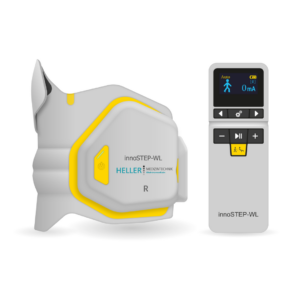
A particularly innovative approach within functional electrical stimulation is the innoSTEP-WLsystem, which is marketed by HELLER MEDIZINTECHNIK. The therapy is applied directly to the movement sequence: A sensor detects the swing phase of walking, while targeted electrical impulses activate the peroneal nerve or the foot lifters. This causes the tip of the foot to lift at exactly the right moment. The result is a more dynamic foot lift, a more natural gait pattern and a significant reduction in the risk of stumbling. At the same time, the application supports the maintenance of the muscles and promotes blood circulation as well as neuronal reorganization through repeated, correct movement patterns. The system is particularly suitable for everyday use thanks to its wireless, discreet design and the fact that it can also be used barefoot.

More mobility in everyday life again

Foot drop after a herniated disc can be stressful – both physically and emotionally. This makes early diagnosis and individual treatment and care all the more important.

Modern aids can help those affected to participate more safely and actively in everyday life again and promote their mobility in the long term.

You can find out more about weak foot dorsiflexion and slipped discs as well as support with modern aids here: https://www.heller-medizintechnik.de/portfolio/fussheberschwaeche/bandscheibenvorfall/

More news

Eine Pflegerin und eine MS-Patientin mit Fußheberschwäche lächeln in die Kamera

Foot drop in multiple sclerosis: causes, effects and support options

Foot drop is a common symptom of multiple sclerosis (MS) and can have a significant impact on everyday life. Those affected have difficulty lifting their foot when walking – this can lead to unsteadiness, stumbling and an increased risk of falling. Many experience not only physical limitations, but also growing insecurity in daily life.

Read more "
Ältere Menschen joggen gemeinsam in der Natur

Fresh air & new energy: why exercise is healthy

With the first warm rays of sunshine and the fresh green of nature, many people automatically feel the urge to spend more time outdoors again. Spring is not only a new beginning for nature, but also an ideal opportunity to revitalize your body and recharge your batteries.

Read more "
Biofeedback Therapie

Biofeedback explained simply: how to better understand and control your body

Biofeedback makes invisible bodily processes visible – and this is precisely where its strength lies. Processes such as muscle tension, heartbeat and breathing normally take place unconsciously. With biofeedback, you learn to consciously perceive and actively influence these processes.
The goal: more control over your own body, fewer complaints and a significantly improved quality of life.

Read more "
Eine Frau mit Fußheberschwäche trägt die Manschette innoSTEP-WL als Hilfsmittel

Foot drop: help with innoSTEP-WL

Foot drop can have a significant impact on everyday life – especially in situations that are actually taken for granted. This includes climbing stairs: What is automatic for many people quickly becomes a challenge for those affected.

Read more "
Cookie Consent with Real Cookie Banner