
What is behind weak foot dorsiflexion?
In MS, the immune system attacks the protective sheaths of the nerves. This disrupts the signal transmission between the brain and muscles. If the nerve impulses no longer reach the muscles in the foot correctly, the foot can no longer be lifted in a targeted manner. This phenomenon is often visible as a “stepper gait”: those affected lift their leg unnaturally high to avoid dragging the tip of the foot.
Effects on everyday life
The limitations caused by weak foot dorsiflexion go beyond simply walking. Many sufferers report
- Increased risk of falling
- faster exhaustion when walking
- limited mobility
- Uncertainty on uneven ground
These factors can lead to a reduction in activities and a lower quality of life.
What support options are available?
The good news is that there are now numerous ways to improve mobility despite weak foot dorsiflexion. Modern aids and targeted therapies help to make everyday life more active and safer again.
These include, among others:
- Orthoses that hold the foot in the correct position
- Functional electrical stimulation (FES), which specifically activates the muscles
- Physiotherapy to improve strength, coordination and gait
-

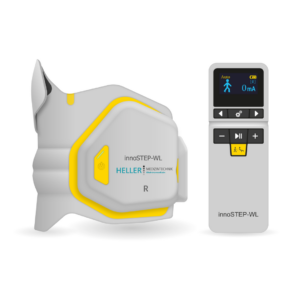
innoSTEP-WL – wireless foot lifting system with remote control
4.990,00 €incl. VAT
zzgl. Versandkosten
Select options This product has multiple variants. The options may be chosen on the product page
A particularly innovative approach within functional electrical stimulation is the innoSTEP-WLsystem, which is marketed by HELLER MEDIZINTECHNIK. The therapy is applied directly to the movement sequence: A sensor detects the swing phase of walking, while targeted electrical impulses activate the peroneal nerve or the foot lifters. This causes the tip of the foot to lift at exactly the right moment. The result is a more dynamic foot lift, a more natural gait pattern and a significant reduction in the risk of stumbling. At the same time, the application supports the maintenance of the muscles and promotes blood circulation as well as neuronal reorganization through repeated, correct movement patterns. The system is particularly suitable for everyday use thanks to its wireless, discreet design and the fact that it can also be used barefoot.
Why early action is important
Early detection and the right treatment play a key role. The sooner measures are taken, the better mobility can be maintained and the progression of poor posture or consequential damage avoided.
Competent support in everyday life
HELLER MEDIZINTECHNIK supports those affected with expert advice and suitable solutions. The aim is to understand individual needs and provide aids that provide real support in everyday life.
Conclusion
Foot drop in MS is a challenge – but not one that you face helplessly. With the right combination of therapy, aids and expert advice, safety, mobility and quality of life can be noticeably improved. The key is to take action and make use of appropriate support.
If you would like to find out more about foot drop and MS, you can find further information at:
Foot drop and MS.