Electric cuff helps with foot drop paresis

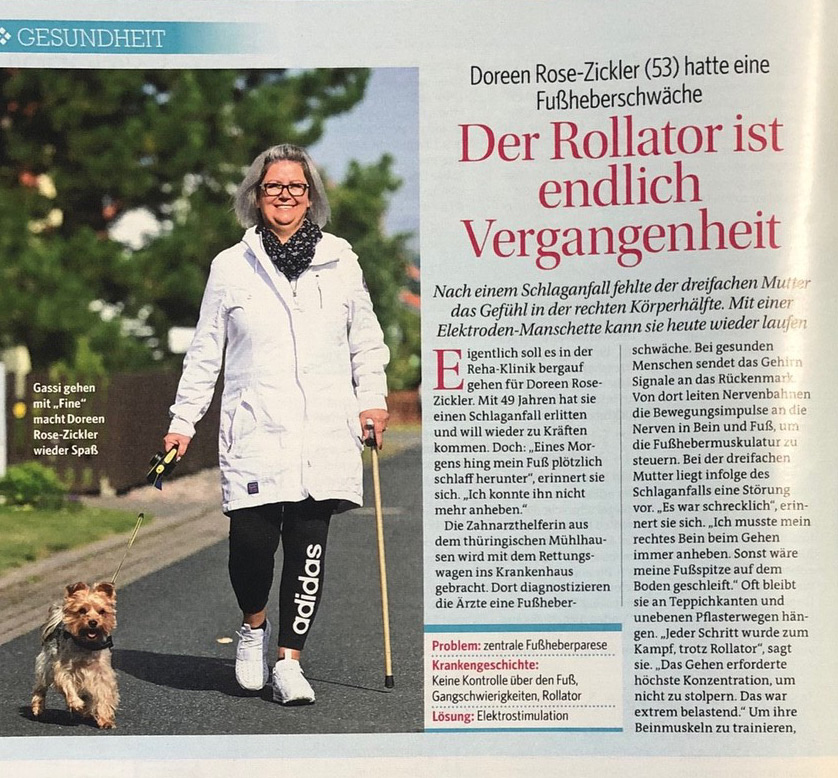
“The rollator is a thing of the past.” After a stroke, slipped disc or traumatic brain injury, nerve damage can also lead to a loss of control when moving the foot. Those affected can then barely lift their foot, which leads to considerable limitations. Functional electrical stimulation (FES) helps to regain mobility.

Without the electric cuff, she often got stuck on carpet edges and paving stones. “I always had to lift my right leg when I walked. Otherwise the tip of my foot would have dragged across the floor. Walking requires maximum concentration to avoid tripping. That was extremely stressful.”

Prof. Dr. Liebetanz, senior physician at the Department of Neurology at the University of Göttingen, describes it as follows: In the case of central foot drop paresis, for example after a stroke, the nerve impulses that control the lifting of the foot fail to occur. This impulse is replaced by the stimulator.

This works by means of an electronic cuff that is attached below the knee. This is easy to put on and can be worn under trousers without any problems thanks to its flat design. “When I start walking, I briefly feel a tingling sensation in my leg due to the electrical impulse,” explains Ms. Rose-Zickler. The electrode cuff automatically sends the movement impulse at the moment the step is taken. Patients with central plantar palsy are thus able to walk normally – for greater mobility and quality of life. “Today I am happy to be able to walk again without a rollator,” says Ms. Rose-Zickler.

The innoSTEP-WL foot lift system is an innovative aid for electrical stimulation in cases of foot lift weakness – caused, for example, by apoplexy, a slipped disc or multiple sclerosis. The electrical cuff can be prescribed by the treating doctor and covered by health insurance.

More news

Biofeedback Therapie

Biofeedback explained simply: how to better understand and control your body

Biofeedback makes invisible bodily processes visible – and this is precisely where its strength lies. Processes such as muscle tension, heartbeat and breathing normally take place unconsciously. With biofeedback, you learn to consciously perceive and actively influence these processes.
The goal: more control over your own body, fewer complaints and a significantly improved quality of life.

Read more "
Eine Frau mit Fußheberschwäche trägt die Manschette innoSTEP-WL als Hilfsmittel

Foot drop: help with innoSTEP-WL

Foot drop can have a significant impact on everyday life – especially in situations that are actually taken for granted. This includes climbing stairs: What is automatic for many people quickly becomes a challenge for those affected.

Read more "
Heller Medizintechnik wünscht Frohe Ostern

HELLER MEDIZINTECHNIK wishes you a Happy Easter!

The Easter holidays not only mark the start of a short break from everyday life, but also a time of new beginnings. Spring brings longer days, more light and new energy – ideal conditions for making a conscious effort to look after your health again.
Now is a particularly good time to integrate exercise into your daily routine, enjoy the fresh air and recharge your batteries. It is often small changes that make a big difference in the long term.
HELLER MEDIZINTECHNIK wishes you a relaxing Easter holiday, new motivation and a healthy start to the sunny season.

Read more "
Ein älterer Mann joggt in einem Wald

Active into spring: how electrotherapy can support muscles and joints

With the first warm days of spring, many people feel the urge to exercise. Walks, bike rides or gardening – after the quiet winter months, the body is more actively challenged again. However, especially when muscles and joints have been under less strain for a long time, tension, sore muscles or complaints in the musculoskeletal system can occur. This is where electrotherapy can provide useful support.

Read more "
Ein Mann geht an einem Rollator, weil er eine Fußheberschwäche hat.

Foot drop after stroke: What treatment options are there – and when is FES useful?

A stroke often changes life from one moment to the next. In addition to speech or memory problems, weakness in lifting the foot (medical term: peroneal nerve palsy) is one of the most common motor impairments. Those affected cannot lift the forefoot sufficiently – the gait becomes unsteady and the risk of falling increases significantly.
But what treatment options are there? And when is functional electrical stimulation (FES) a sensible solution?

Read more "
Cookie Consent with Real Cookie Banner