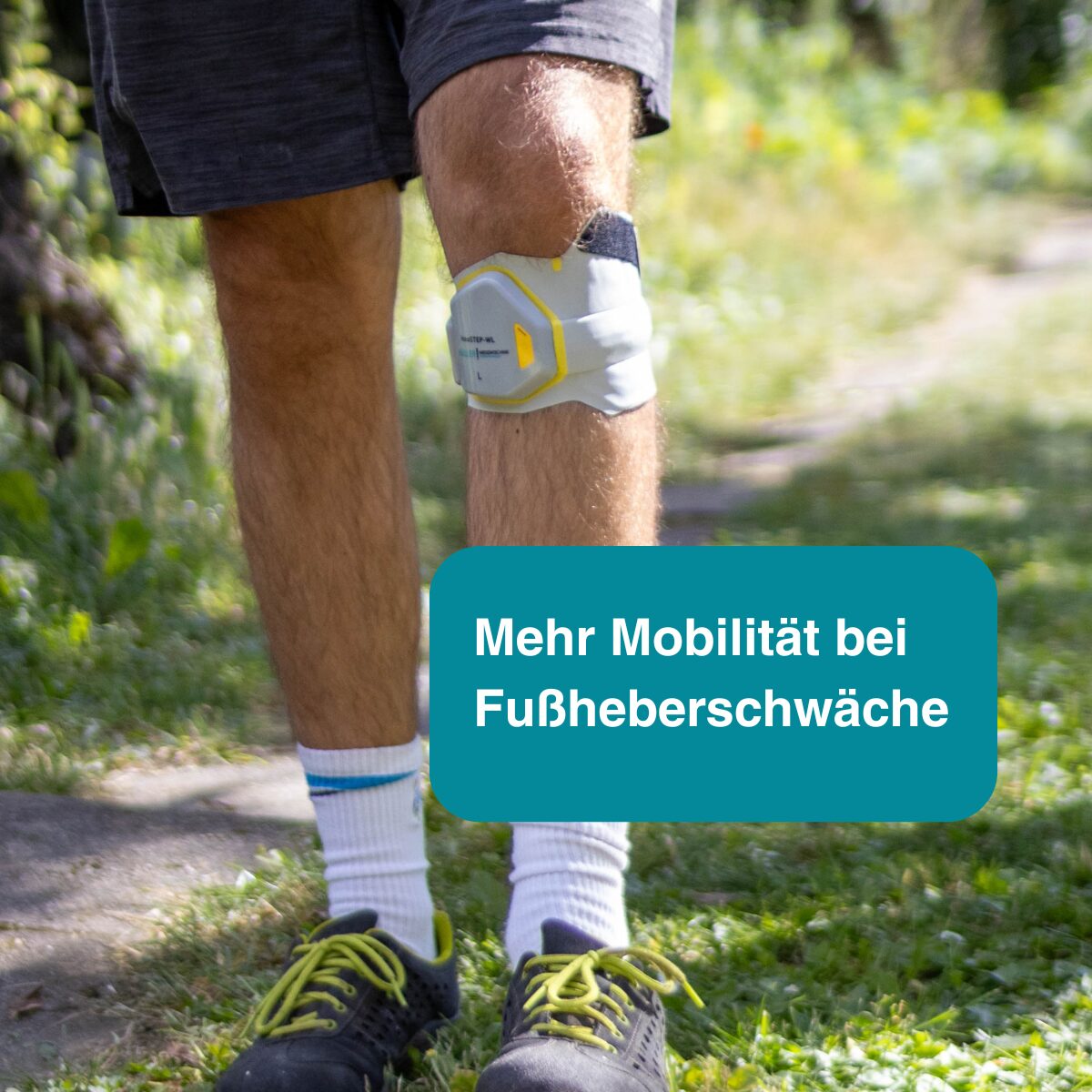

More mobility thanks to innoSTEP-WL: How our patient with weak foot dorsiflexion is walking safely again

With the wireless foot drop system innoSTEP-WL, people with foot drop weakness gain more confidence and stability when walking thanks to MS. The difference can be seen in the video: our patient first walks without support and then with a significantly improved gait pattern.

The wireless foot drop system innoSTEP-WL improves walking with foot drop due to MS and shows impressive progress in everyday life.

Foot drop is a common consequence of neurological diseases such as multiple sclerosis (MS). Those affected have difficulty lifting their foot when walking, which makes walking unsteady and strenuous. Climbing stairs, longer distances or uneven surfaces pose major challenges. This is precisely where the wireless innoSTEP-WL foot lifting system comes in.

The before-and-after effect is often impressive: without support, the gait appears wobbly and laborious. As soon as the innoSTEP-WL is activated, the foot lifts off again effortlessly and the gait becomes more fluid and stable. Patients can move more safely, climb stairs or even walk barefoot without having to rely on orthoses. The system stimulates the affected muscles through functional electrical stimulation and supports the nerves so that the muscles are contracted in a targeted manner.

Another advantage: the innoSTEP-WL is easy to use, can be worn flat and inconspicuously under clothing and can be prescribed by health insurance companies. This not only increases mobility, but also significantly improves the quality of life of those affected.

Information on MS and foot drop:
Foot drop often occurs in people with MS because the nerve impulses between the brain and foot are impaired. This makes it difficult to lift the foot and increases the risk of falling. Find out more about foot drop and MS here.


More news

Die Behandlung einer Fußheberschwäche mit dem medizinischen Gerät innoSTEP-WL

What are the causes of weak foot dorsiflexion?

Foot drop is a neurological symptom in which the foot can no longer be actively lifted. Medically, it is also referred to as foot drop, peroneal palsy, peroneal paralysis, drop foot or colloquially as “foot drop disease”. All of these terms have the same problem in common: the control of the foot lifter muscles is impaired.
Typical is the altered gait pattern, the so-called stepper gait. Those affected lift their knees and hips excessively when walking in order to prevent the toes from getting caught.

Read more "
Zwei Personen mit Fußheberschwäche gehen spazieren

More safety and stability when walking despite weak foot dorsiflexion

Walking is something that most people take for granted – but if you have weak foot dorsiflexion, every step can become a real challenge. Those affected have difficulty lifting the forefoot during the swing phase. The foot drags on the ground, the gait becomes unsteady and the risk of tripping or falling increases significantly.

Read more "
Ein Ehepaar läuft durch einen Wald, der mit Schnee bedeckt ist.

Relieving pain in the cold season – with exercise, everyday tips and modern TENS therapy

As the days get shorter, freezing temperatures set in and we spend more time indoors, many people start to feel pain again. Especially in winter, those affected complain more often about back, joint or muscle pain. The good news is that with the right combination of exercise, small everyday measures and modern medical technology, aches and pains can be alleviated even in the cold season.

Read more "
Cookie Consent with Real Cookie Banner